
Overview
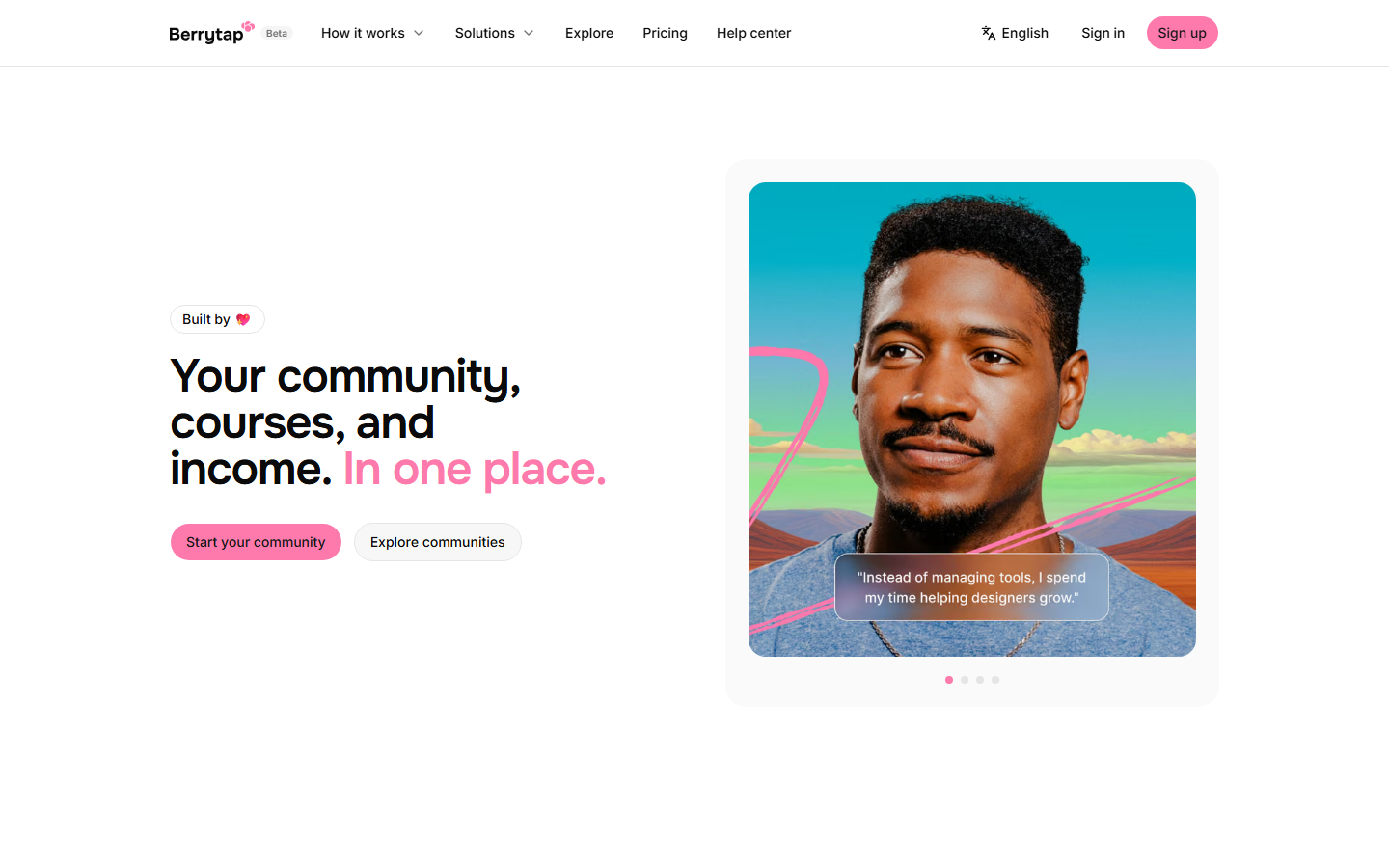
Berrytap is a platform for people who teach. A creator spins up a paid community and gets a social feed, a course builder, live rooms, a calendar, memberships and payouts in one place — instead of stitching together a Facebook group, a Google Drive folder, a Zoom link and a bank transfer.
It is the first thing I have designed and built end to end. Every screen, every schema, every Stripe webhook. My primary tool was Claude Code, which is what made a solo build of this size possible at all.
The problem
Mongolian creators who sell knowledge run their business across four disconnected tools. The community lives in a Facebook group, the course sits in Google Drive, the live session is a Zoom link pasted in a comment, and payment is a bank transfer that someone checks by hand.
Nothing talks to each other. There is no way to know who paid, no way to gate content behind a membership, and no way to see whether anyone actually finished the course. The creator spends more time on admin than on teaching.
Skool solves this everywhere except here. It cannot take a Mongolian payment, and it does not speak Mongolian.
One product, two payment rails
This is the decision that shaped the whole architecture.
A Mongolian creator cannot be paid by Stripe Connect — it does not pay out to Mongolia. A global creator cannot be paid by QPay. Supporting both meant the platform had to hold two completely different money flows without the creator ever seeing the seam.
So a community picks its payout model at creation, from its country, and that choice is permanent:
Global creators
Stripe Connect Express, priced in USD. Stripe pays the creator directly and Berrytap only ever takes an application fee. We never hold their money.
Mongolian creators
QPay and card through a local processor, settled in MNT. The balance sits in our ledger, holds for seven days, then the creator requests a payout.
Two rules keep it honest. The ledger is append-only — a correction is a new row, never an edit. And no balance is ever stored; a balance is always the sum of its entries. Money bugs are the kind you cannot apologise your way out of, so the data model refuses to let them happen quietly.
The payout model drives the payment UI, never the language setting. A Mongolian creator reading the English site still gets QPay.
Pricing that gets cheaper as you grow
Most platforms take a bigger cut as you succeed. Berrytap inverts it — the monthly fee goes up, the platform fee goes down, and at the top tier it disappears.
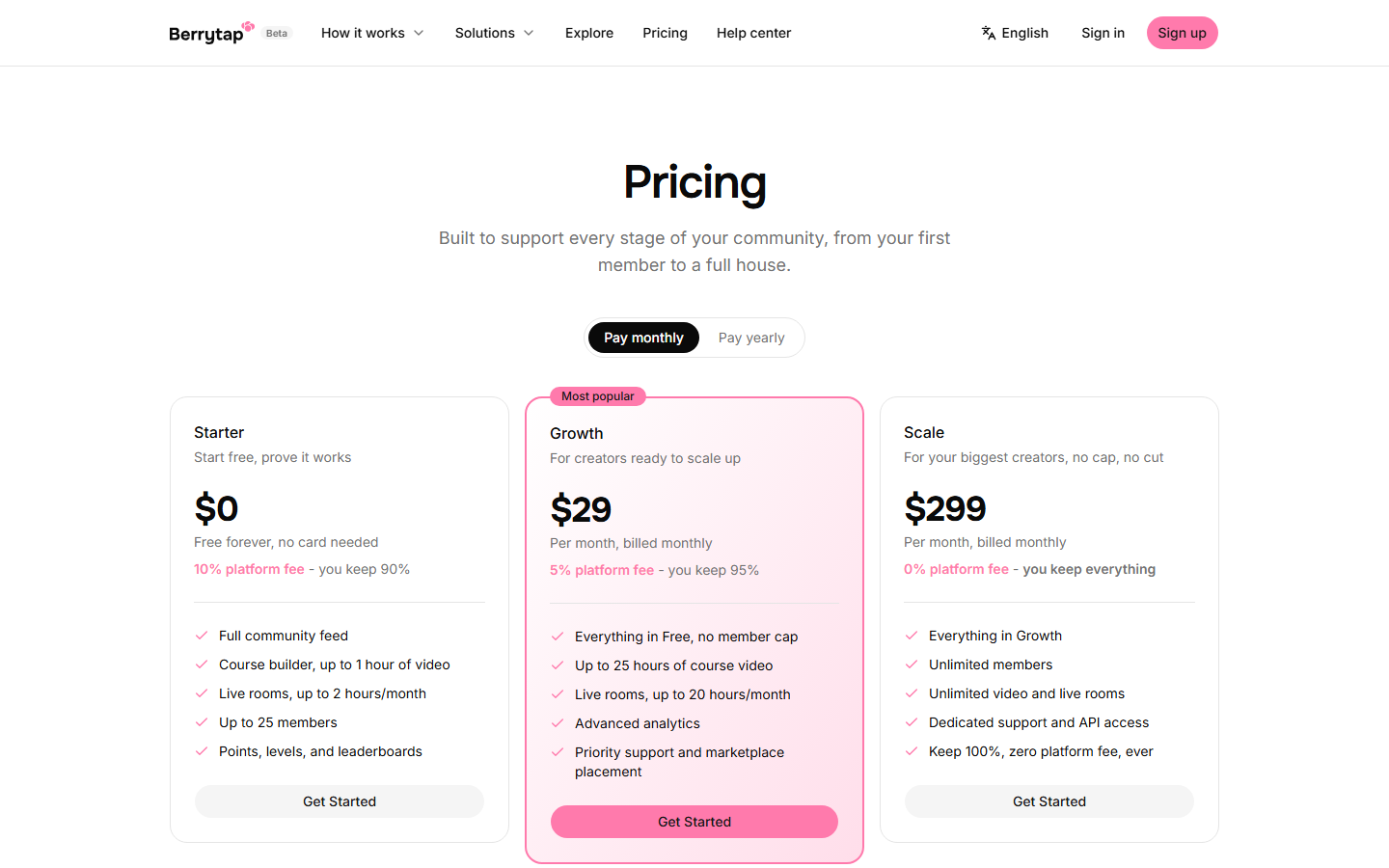
The free tier is a real product, not a trial. Full feed, course builder, live rooms, points and leaderboards, up to 25 members. A creator can prove the thing works before paying anything, which matters a lot in a market where nobody has heard of you yet.
What is in the box
Community feed
Posts, comments and reactions, with points, levels and leaderboards to keep members coming back.
Course builder
A rich-text editor with video lessons and progress tracking, built on Tiptap.
Live rooms
Real-time video sessions through LiveKit, metered by tier.
Memberships
Recurring subscriptions or one-time access, with invoices, renewals and payouts handled automatically.
The whole app is bilingual, English and Mongolian, through next-intl. That is not a translation layer bolted on at the end — it was there from the first screen, because the beachhead market reads Cyrillic and the pitch is "started in Mongolia, built for the world."
Building it solo with AI
The stack is Next.js 16 and React 19 on Supabase, with Stripe Connect, LiveKit, Tiptap and shadcn/ui on Radix. I wrote almost none of it by hand.
What I learned is that the bottleneck in AI-assisted building is not code generation, it is constraints. The project carries a CLAUDE.md that states the rules an agent has to hold in mind — the ledger is append-only, never store a balance, never let Stripe into a Mongolian path or QPay into a global one. Without those written down, an agent will cheerfully produce a plausible, broken payment flow.
Designing and building the same product also collapsed a loop I have spent my whole career on. There was no handoff, no spec doc, no "can we actually do that?" Every design decision got tested against the database schema the same hour I made it.
Where it is now
Live in beta at berrytap.com. 300 users, 5 community owners running paid groups, and a product that is still being fixed in public every week.
Next up is finishing the marketplace, hardening the payout flow, and getting the first cohort of Mongolian creators fully paid out through the local rail.